Showing posts with label animal of the month. Show all posts

Tuesday, February 1, 2011

Animal of February: The Giant Panda

The social giant panda can be found in Central China in the bamboo forests munching on bamboo sticks. These omnivorous gentle giants can weigh 300 pounds and stand about four to five feet tall.


The panda is on the endangered species list. There are only about 100 pandas left in the world.


The Fast Facts
1) Omnivore
2) Weight: 300 lbs
Height: 4 to 5 ft tall
3) Endangered
4) Range: Central China
Habitat: bamboo forests and mountains


Thanks for reading!
PawPrint

Wednesday, January 12, 2011

Animal of January: the Koala


The cute and popular koala bear is known by many for its teddy bear-looking physical features. However, this mammal is not a bear it is a marsupial, a pouched animal. These marsupials live in eastern Australia in the eucalyptus forests. Koalas have sharp claws to help them climb trees, which is where they spend most of their time. Koalas rarely leave their beloved eucalyptus trees, and often doze off tucked high up in the trees. Koalas sleep for about 18 hours a day. Koalas eat about 2 ½ lbs of eucalyptus leaves a day. Koalas do not drink that much, they get most of the moisture from the eucalyptus leaves. Since the koala eats eucalyptus leaves, the koala is an herbivore.


Fast Facts

1. Herbivore

2. Range: Eastern Australia

3. Habitat: Eucalyptus forests


National Geographic Animal Facts

Wednesday, November 17, 2010

The Animal of the Month: The Tapir

The tapir, with its long nose, looks like a hippo/cow/horse/rhino, but is really related to the horse and rhinoceros family. They use their long trunks to pick tasty fruits off the trees, and clean themselves. Like hippos, tapirs often submerge in water to cool off. Tapirs are endangered herbivores that live in the forests and grasslands of Central and South America. Tapirs have been on Earth longer than humans, and scientists believe they have not changed much over the tens of millions of years they have been here. Below is a Malayan Tapir.


There are four types of tapirs-- Malayan Tapir, the Brazilian (or Lowland) Tapir, the Mountain Tapir, and Baird's Tapir. All four species of tapir are endangered. The Mountain tapir (below), or wolly tapir, is the smallest.


He looks like a small black bear with a big nose. You can see a Brazilian tapir below.


And last but not least, below is the Baird's tapir.


The Fast Facts
1. Size: weighs 500 to 800 lbs
2. herbivores
3. Protection Status: endangered
4. Group name: a candle
5. Did you Know? Tapirs have 14 toes!


Thanks for reading!
PawPrint


Thank you to National Geographic Animal facts

Thursday, September 2, 2010

The Animal of September: The Bottlenosed Dolphin!

With a familiar smile and a silly personality, the Bottlenosed dolphin is an intelligent aquatic mammal that can swim over speeds of 18 miles an hour. Dolphins are very social animals that live in groups known as pods. They communicate in various different sounds of whistles. Dolphins are carnivores, eating fish, shrimp, and squid. These sneaky critters are also seen sometimes following fishing boats to see if there is anything left over to eat.


Bottlenosed dolphins are found in the warm tropical waters all around the world. Dolphins were once hunted for meat and oil, but are now protected and dolphin fishing is limited. The average lifespan of a bottlenosed dolphin is 45 to 50 years. They can grow to be about 10 to 14 ft long, and weigh about 1,100 lbs. Dolphins can jump 16 ft out of the water and land with a big splash on their side or their back.


The Fast Facts
1. Carnivore
2. Average lifespan in the wild: 45 to 50 years
3. Weight 1,100 lbs
4. Group name: a pod
5. marine mammal

Sunday, August 8, 2010

The Animal of August: The Mandrill!

Being the largest of the monkeys, the mandrill is a shy animal that live only in the rain forests of equatorial Africa. They are 3 ft tall omnivores, eating fruits, nuts, insects, amphibians, and reptiles. They weigh 77 pounds, and they live in troops. The troops are lead by males, and include a dozen or so females and their young. Mandrills have a way of being cute and creepy all at the same time!


Mandrills do not fall in the category of endangered, yet they are a threatened species. They are hunted for bushmeat, as many Africans consider them a delicacy.


Fast Facts!

1. Omnivores
2. Lifespan in the wild: 20 years
3. Group: troop
4. Size: 3ft tall, 77 lbs
5. Protection status: threatened

Thursday, July 1, 2010

The Animal of July: The Sea Otter

The carnivorous aquatic member of the weasel family spends most of his time in the water. The sea otters will eat, rest, and socialize in the water. They live in groups in the water and are very playful. They eat things such as clams, shellfish, sea urchins, crab, squid, octopus, and fish. They weigh about 65 pounds, and live up to 23 years in the wild. Sea otters were once to the point of extinction in the early 20th Century, with only about 1,000 to 2,000 otters left. Now, with protection laws, there are about 100,000 to 150,000 otters in the wild.


Fast Facts
1. Carnivores
2. Weigh about 65 pounds
3. about 4 ft tall

Tuesday, June 1, 2010

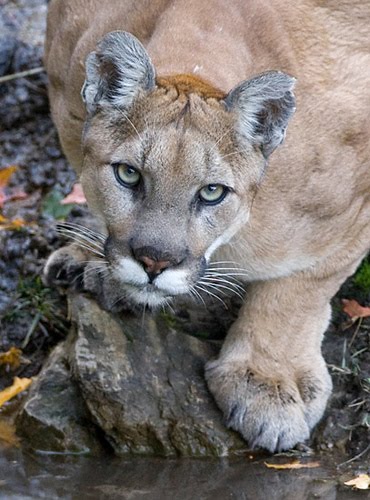
Animal of the Month: The Mountain Lion

The huge 136 pound mountain lion roams America. The mountain lion is also known as a puma, cougar, and catamount. Mountain lions are carnivores, preying on deer, porcupine, coyotes, and raccoons. They tend to prey at dawn or dusk.


Mountain Lions once roamed all of America, but that was reduced in the Midwest and Eastern U.S. Hunters treasured these mountain lions, while farmers despised them for killing their livestock. Does that sound familiar? Remember back in January, the animal of the month was the wombat. Farmers didn't like wombats for destroying their fields, and farmers don't like mountain lions for killing their cows.

Mountain lions are very quiet and shy animals, rarely seen by humans. They need a lot of space to roam and live. Now, based on that information, why do you thing mountain lions will sometimes attack humans?

If you live in Pleasanton, you might remember the mountain lion spotting near Mohr Elementary School back in 2006, and then again in 2009. This endangered species has no place to roam anymore, being forced into rural areas, which then leads them to be killed because of "threatening" people, while most of the time they don't even harm anyone. It's just wrong. Here is the link for PleasantonWeekly.com on the mountain lion spotting in 2009 http://www.pleasantonweekly.com/news/show_story.php?id=1959

Fast Facts!
1. Carnivore
2. They weigh 136 lbs
3. Endangered
4. Live in the Western parts of America


Thanks to National Geographic Animal Facts: http://animals.nationalgeographic.com/animals/mammals/mountain-lion/

Wednesday, May 5, 2010

Animal of the Month: The Elephant Seal!

The carnivorous elephant seal has two species: the northern and the southern seal. Southern elephant seals live in sub-Antarctic and Antarctic waters that contain brisk cold conditions but are rich in the fish, squid, and other marine foods that the seals enjoy. Southern elephant seals are the bigger of the two. Souther males can be up to 20 ft tall and weigh 8,800 pounds! Northern elephant seals can be found in California and Baja California, though they prefer to frequent offshore islands rather than the North American mainland. Elephant seals are sometimes called Sea Elephants. Sea elephants are interesting looking creatures...


Elephant seals were intensely hunted for their oil, and their numbers were once brought down to the brink of extinction. Fortunately, populations have come back and they are under legal protections. Southern elephant seals can dive over 4,921 ft deep and stay submerged for up to two hours! Below you can see a southern elephant seal. I think they're cute..:)


Now you can see a northern elephant seal.. :)


Fast Facts:
1. Carnivore
2. Weigh: Up to 8,800 lbs
3. Group: Colony
4. Lifespan in the Wild: 9 years for northern 20 to 22 years southern


National Geographic Animal Facts

Saturday, April 10, 2010

Animal of the Month: The Manatee!

Manatees are 440 to 1,300 pound sensitive mammals. They are very endangered, found in the shallow waters of Florida, Brazil, and some species in Africa and the Amazon river. They live about 40 years in the wild. They are herbivores.


They are endangered because when they come up for air, and gently let their backs float above the water, they get scrapped by boats. With big gashes, these animals are very soon extinct. Want to find ways to help? Go to http://www.savethemanatee.org/default.html Manatees are herbivores.


Info from http://www.savethemanatee.org/default.html
http://animals.nationalgeographic.com/animals/mammals/manatee.html

Friday, March 26, 2010

Animal of the Month: The Arctic Hare

How many of you like rabbits? Well, personally, I love rabbits, and Arctic animals, so, the animal of March is the Arctic hare. The arctic hare hops around the freezing arctic Tundra (click to see picture) with speeds of about 40 mph. Because the arctic hare has so many adaptations to the brisk conditions of the Tundra, it does not hibernate. In the winter, the hare is white, to blend in with the snow, and in the summer it turns a blue-ish brown color.


Fast Facts

1. Omnivore
2. Range/Habitat: Arctic Tundra
3. Weigh 6 to 15 lbs
4. They do not hibernate
5. Will huddle together for warmth


Thanks to National Geographic Animal Facts: http://animals.nationalgeographic.com/animals/mammals/arctic-hare/

Saturday, January 2, 2010

Animal of the Month: The Wombat!

The very fat and pudgy wombat roams the eucalyptus forests and grasslands of Australia. It is nocturnal, eating grasses, roots, and bark at night. It weighs from 30 to 80 pounds. Wombats have a very slow metabolism—it can take 14 days to digest one meal!
Wombats are fat with light brown fur and sharp claws to burrow in the dirt and the grassy fields.

When wombats burrow in fields, the field gets ruined. This can be very annoying to farmers, and wombats have even been killed for their behavior. They are also killed for their fur and simply just for sport. Some of their species, like the Northern Hairy-Nosed wombats, are critically endangered, while some are getting to the point of being endangered.


The Fast Facts-
1. Herbivores, eating grasses, roots, and bark
2. Range: Australia
3. Habitat: Eucalyptus forests and grasslands
4. Weigh 30 to 80lbs

Sunday, December 6, 2009

Animal of the Month: The Platypus

The Platypus is a very odd animal. It is venomous and sort of a mix between a beaver, a duck, and an otter. It has otter-like feet, a duck-like bill, and a beaver-like tail. Male platypuses have a pouch on their foot that can shoot venom, which is very painful to humans.

Platypuses are responsible for the belief in mermaids.(1) Sailors saw these strange creatures, thinking they were half fish, half women. With the weird animals, and the possibility of drunk sailors, the belief of the mermaid is now throughout the world.

The Facts:
The platypus weighs about 3 lbs, and lives off the coasts of Tasmania and Australia. Their lifespan is generally 12 years.


Resources (MLA citations)
National Geographic. “Platypus” National Geographic Society 2009. 6 Dec 2009
http://animals.nationalgeographic.com/animals/mammals/platypus.html

(1) Animal Planet. “Platypus” Animal Planet 2009. 6 Dec 2009 http://animal.discovery.com/mammals/platypus/